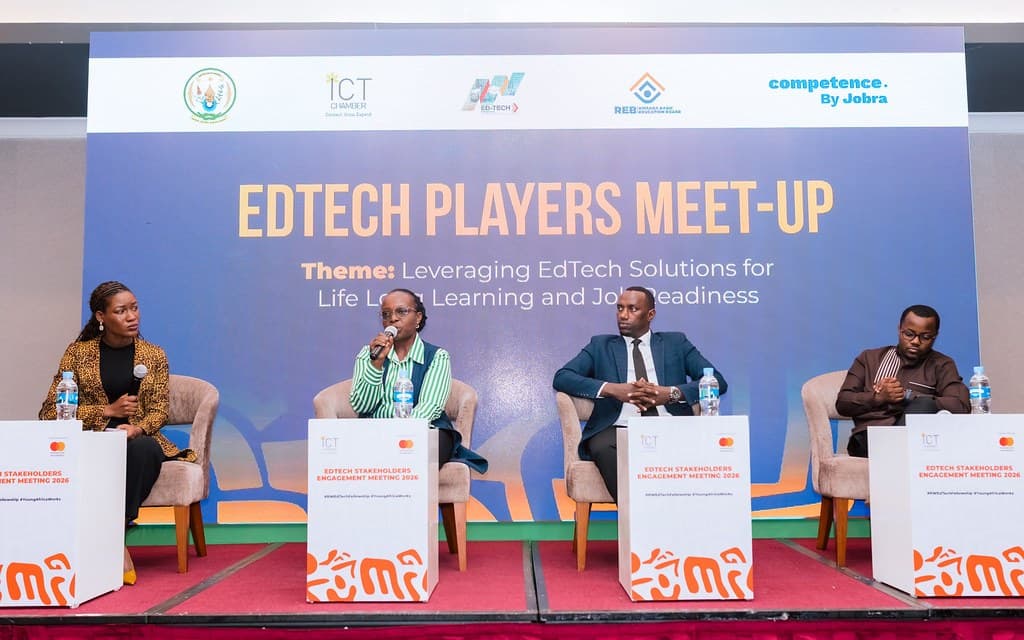
Rwanda’s push to expand education technology is entering a new phase, with policymakers, innovators and development partners increasingly focused on whether digital learning can translate into skills, employment and economic opportunity rather than simply wider access to devices and connectivity.
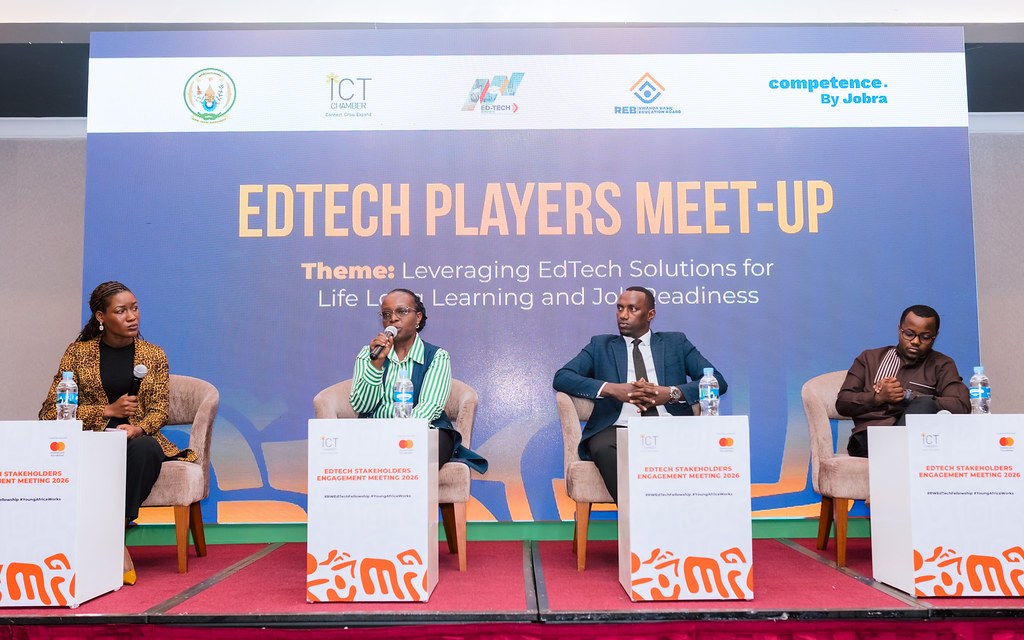
EdTech Mondays October Players Meet-Up panelists.
The shift was a central theme at the combined EdTech Stakeholders Engagement Meeting and EdTech Players Meet-Up held in Kigali on Oct. 2 under the theme “Leveraging EdTech Solutions for Lifelong Learning and Job Readiness.” The gathering brought together education, technology, government and private-sector stakeholders to examine how digital solutions can respond to a labor market being reshaped by artificial intelligence, automation and changing skills requirements.
For Rwanda ICT Chamber Chief Executive Officer Alex Ntale, the next challenge is ensuring that innovation reflects problems faced by learners, teachers and communities rather than assumptions made by technology developers.

Rwanda ICT Chamber Chief Executive Officer Alex Ntale giving his opening remarks.
“Whatever the innovators and the entrepreneurs are building in the laboratories and the fancy offices” needs to be aligned with “the needs on the ground,” Ntale said, pointing to educators, learners and parents as key users whose realities should shape product development.
That disconnect can become costly when solutions reach the market without sufficiently understanding how schools and communities operate. Rwanda’s EdTech ecosystem has expanded across digital learning, skills development, assessment, teacher development and school management, but the sector still faces uneven adoption, affordability and accessibility constraints, as well as weak links between technology providers and employers.
Dr. Diane Sengati, acting head of ICT in Education at the Rwanda Basic Education Board, said the country has already built much of the digital foundation needed to take the next step.
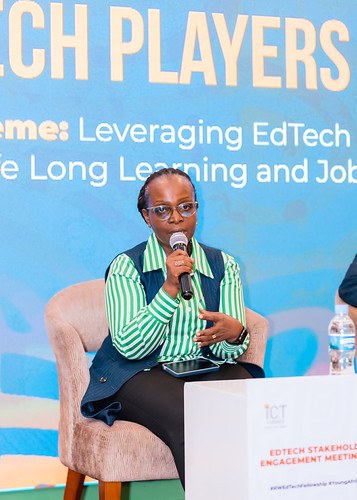
Dr. Diane Sengati, acting head of ICT in Education at the Rwanda Basic Education Board, giving her insights during the panel discussions.
Government and partners have invested in teacher training, connectivity, devices and digital platforms, she said. About 10 years after Rwanda began distributing devices to schools, Sengati said close to 90 percent of schools now have access to both connectivity and devices, although gaps remain.
The bigger question, she said, is how effectively that infrastructure is being used.
“The goal is not for teachers, I mean the school administrations, to be recording the students and recording also some of the data related maybe to accounting,” Sengati said. Instead, technology should become part of teaching and learning across subjects, with teachers given the skills, confidence and support to use digital tools in their classrooms.
That means moving beyond technology as an object and treating it as a productivity tool for educators. Sengati argued that digital solutions should help teachers reduce repetitive manual work, improve assessment and engage students more actively in learning.
“We come from the devices and then to actually apply and do our job to see how actually technology will be facilitating us doing our job,” she said. “Rather than thinking that maybe technology is here to replace the teachers.”
The employment dimension becomes even more important for underserved populations, including refugees.
Eric Mutabazi, a refugee technical adviser at the Ministry in charge of Emergency Management, said Rwanda has more than 140,000 refugees, with children accounting for 48 percent of the population. He argued that digital learning could help support the government’s objective of making refugees more self-reliant, provided education is connected to actual economic opportunities.

Eric Mutabazi, a Refugee Technical Adviser at MINEMA, sharing his thoughts during the discussions.
“EdTech should not be viewed not only as a way of delivering online courses, but as an ecosystem that connects people to learning skills and economic opportunities,” Mutabazi said.
That requires designing learning around demand in the labor market, including digital literacy, languages and data skills, while ensuring learners can make the transition from education into employment.
“For us as MINEMA, we don't see EdTech's success as how many people have been enrolled into the system,” Mutabazi said. “We need to see the skills acquired” and whether they lead to sustained economic participation.
For EdTech companies, that creates pressure to move faster than traditional education systems can sometimes adapt.
Vivens Uwizeyimana, Founder and Chief Executive Officer of Competence by Jobra, said the pace of technological change is creating a widening gap between formal curricula and emerging employment opportunities. He pointed to artificial intelligence as an example, saying the growth of AI-related jobs is occurring faster than conventional curriculum cycles can respond.

Vivens Uwizeyimana, Founder and Chief Executive Officer of Competence by Jobra, elaborates on his point during the panel discussions.
His prescription is to begin with employers and economic opportunities rather than qualifications alone.
“We are still having an education which is degree-first,” Uwizeyimana said. “And I think it has to change a little around maybe to what can this person do first.”
That would require EdTech providers and education institutions to design learning around demonstrable competencies, including skills that can lead to employment and self-employment. Uwizeyimana also advocated giving students practical work experience before graduation, citing a partnership with the University of Rwanda in which students were exposed to work experience and career-focused skills while still studying.
The message from the EdTech Fellowship Program was similarly centered on outcomes rather than technology for its own sake.
Dieudonné Dusabimana, the program’s manager, said entrepreneurs can have strong products but still struggle to understand the education system, reach decision-makers or find opportunities to test and scale their solutions.
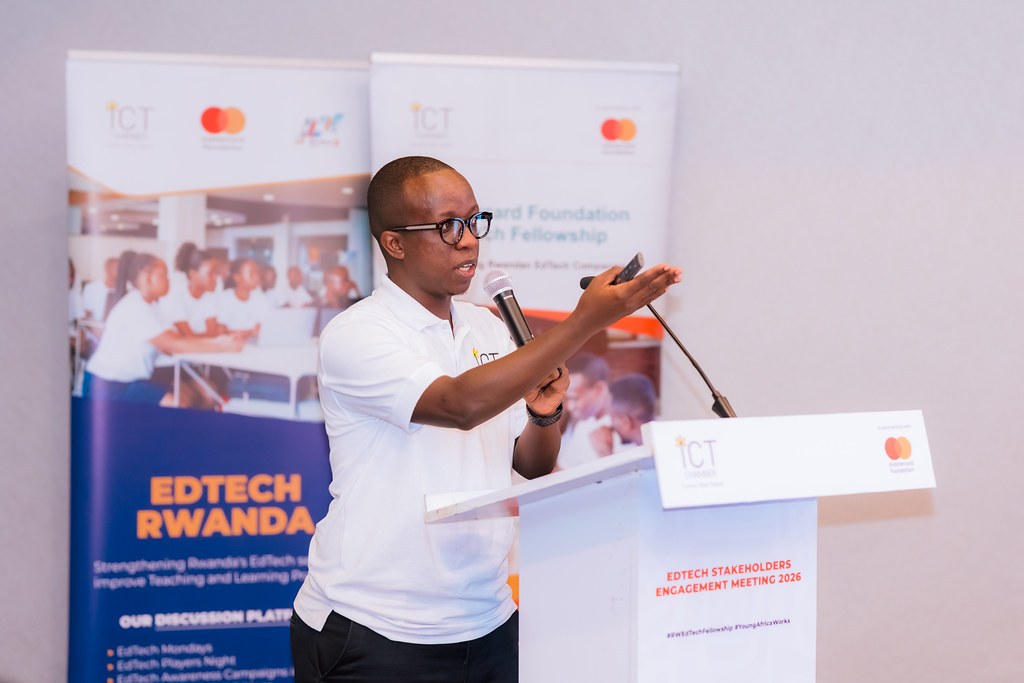
Dieudonné Dusabimana, EdTech Fellowship Program Manager, makes a point during his presentation.
“Technology is not the starting point. The problem is the starting point,” Dusabimana said.
The fellowship is supporting eight companies and challenging them to demonstrate not just how many learners they can reach, but which problems their products solve and what evidence shows that learning outcomes are improving.
That approach reflects a broader shift in Rwanda’s EdTech agenda. The sector’s next stage is less about counting devices, platforms or users and more about proving that technology can improve teaching, develop relevant skills and create clearer pathways into work.
The October Players Meet-Up discussions identified stronger connections between EdTech providers and employers, expansion into TVET, higher education and workforce training, and wider access for women, youth, persons with disabilities and underserved communities as key opportunities. It also highlighted AI and data as tools that could personalize learning and help providers respond to changing skills demand.
For Ntale, achieving that transition will ultimately require collaboration across the ecosystem.
“This is not an ICT Chamber event,” he said, emphasizing that the agenda belongs to the wider education and technology community. The objective, he added, is to “go far and fast” together.
The challenge now is turning that consensus into products, curricula and partnerships that can keep pace with the economy and demonstrate that a learner who enters an EdTech platform emerges with something the labor market is willing to value.