Technology is emerging as a critical bridge for young Rwandans who have been pushed out of formal education, with policymakers, innovators and learners calling for more flexible pathways that connect education to skills, employment and opportunity.
That was the central message of the August edition of EdTech Mondays Rwanda, held under the theme “Alternative Learning Pathways: Technology as a Bridge for Out-of-School Youth.” The discussion highlighted how digital learning platforms, skills-focused programs, innovation hubs and other technology-enabled approaches can help young people overcome barriers to conventional education and create new routes into further learning or the workforce. Rwanda’s education strategy increasingly faces the challenge of ensuring that investments in digital infrastructure reach young people who remain outside the formal system.
According to the Ministry of Education’s 2024/25 Education Statistical Yearbook, 1.07 million young people aged 18 to 22—71.4 percent of that age group, are out of school, while 468,741 children aged 3 to 5 are not enrolled in pre-primary education.

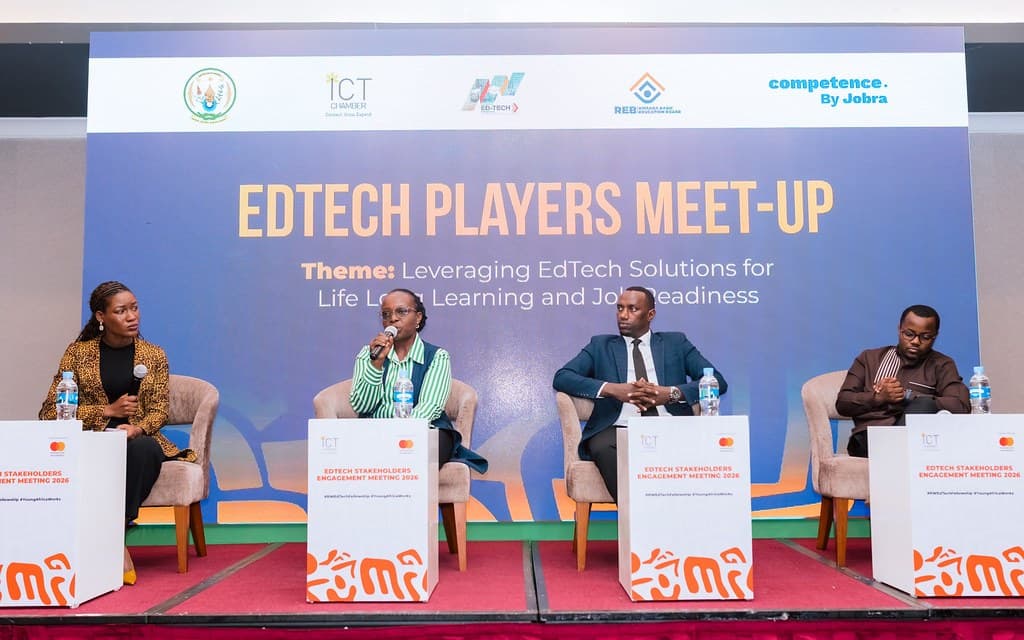
The three panelists and the talk-show host during EdTech Mondays August Edition
For young people affected by financial hardship and other barriers, technology can provide something the traditional classroom cannot always offer: a second route back into learning.

Diane Dushimiyimana, an out-of-school youth who found a new pathway through technology.
“My family’s financial situation forced me to leave school in Senior Six, despite my determination to continue my education,” said Diane Dushimiyimana, an out-of-school youth who participated in the program. “The RISE Program gave me another opportunity to learn, and today I’m using technology to help people in my community access essential services.”
From learning to livelihoods
The discussion also underscored that alternative education pathways must go beyond putting courses online. For young people outside the formal education system, the ultimate test is whether digital learning translates into practical skills and economic opportunities.

Allen Kenduga calls for EdTech to connect digital learning with real-world skills and employment opportunities.
Allen Kenduga, chief executive officer of Talent Match, said technology should connect young people with the skills and experiences demanded by employers.
“The real value of EdTech is not simply putting courses online, it is connecting learning to the real world,” Kenduga said during the show. She said technology can help young people develop digital skills, work in teams, solve real problems, pitch ideas and engage with employers.
That connection between learning and livelihoods is particularly important as Rwanda seeks to build a more skilled, digitally capable workforce.
The August discussion brought together perspectives from education, technical and vocational training, the private sector and young people themselves, reflecting the cross-sector collaboration envisioned by EdTech Mondays Rwanda. The platform is jointly supported by the Mastercard Foundation and the Rwanda ICT Chamber to advance policy dialogue, innovation and collaboration around the country’s EdTech ecosystem.
Ensuring no young person is left behind
For UNICEF, technology-enabled learning offers an opportunity to address some of the structural barriers that keep young people outside education.
Protogene Ndahayo, Education Specialist and RISE Program Manager at UNICEF Rwanda, said alternative learning pathways should be designed around the realities of young people who have been excluded from traditional systems.

Protogene Ndahayo highlights how technology can create second-chance learning opportunities for out-of-school youth.
“Every young person deserves a second chance to learn, grow, and thrive,” Ndahayo said. “Through technology-enabled learning pathways, RISE Rwanda is turning barriers into opportunities and ensuring that no young person is left behind.”
The challenge now is to ensure that these pathways are inclusive enough to reach vulnerable learners, including girls, young people with disabilities and those living in remote communities.
The August Edition also calls for stronger collaboration among government institutions, education agencies, broadcasters, innovation hubs and technology providers to build learning ecosystems that can reach underserved communities.
Building pathways, not just platforms
The discussion points to a broader shift in how education technology is viewed in Rwanda. Rather than treating EdTech simply as a digital substitute for classroom teaching, the August edition explored technology as an enabler of multiple pathways into education, skills development, entrepreneurship and employment.

Panelists and the host after the EdTech Mondays August edition at KT Radio.
For out-of-school youth, that distinction is critical. A platform alone does not remove the economic, social or geographic barriers that caused a young person to leave school. But when technology is combined with practical skills, mentorship, community support and links to employers, it can create a pathway back into learning and productive work.
The August edition therefore closed with a clear message: Rwanda’s digital education ambitions will ultimately be measured not only by how many learners are connected to technology, but by how many young people who were once excluded are given a genuine opportunity to learn, acquire skills and build a future.
As Rwanda advances its ambition of becoming a knowledge-based economy, alternative learning pathways could become an increasingly important part of building an inclusive and resilient workforce, particularly if government, educators, innovators, development partners and the private sector can turn promising initiatives into scalable systems.